If you have ever driven through Hillsborough and wondered why the homes feel so distinct, the answer is bigger than square footage or curb appeal. This town was shaped by estate planning, large parcels, mature landscaping, and a design culture that still influences what gets built and how homes evolve over time. If you are buying, selling, or simply trying to better understand the market, this guide will help you read Hillsborough architecture with a more informed eye. Let’s dive in.
Why Hillsborough Looks Different
Hillsborough still reflects its roots as an estate community. According to the Town, large parcels were being sold by the late 1860s, the town incorporated in 1910, and several major estates were later subdivided while keeping the original homes and several acres intact.
That estate pattern still matters today. The Town says the minimum lot size changed to one-half acre in 1953 and remains in effect, which helps explain why Hillsborough feels more open, layered, and private than many nearby communities.
The visual effect comes from more than lot size alone. Hillsborough’s residential design materials describe a setting defined by curving roads, abundant landscaping, and architectural diversity, with architecture and landscape treated as one visual system.
For you as a buyer or seller, that means a Hillsborough home is rarely just a structure. It is also about how the house sits on the land, how the approach unfolds from the street, and how the landscape supports the architecture.
Classical Estates Set the Tone
Some of Hillsborough’s most recognized homes sit within the classical tradition. The Town describes Carolands as one of the finest examples of French Classical architecture in America, and the California Office of Historic Preservation describes Newhall Estate as a Beaux-Arts Classical residence with French influences in both style and site planning.
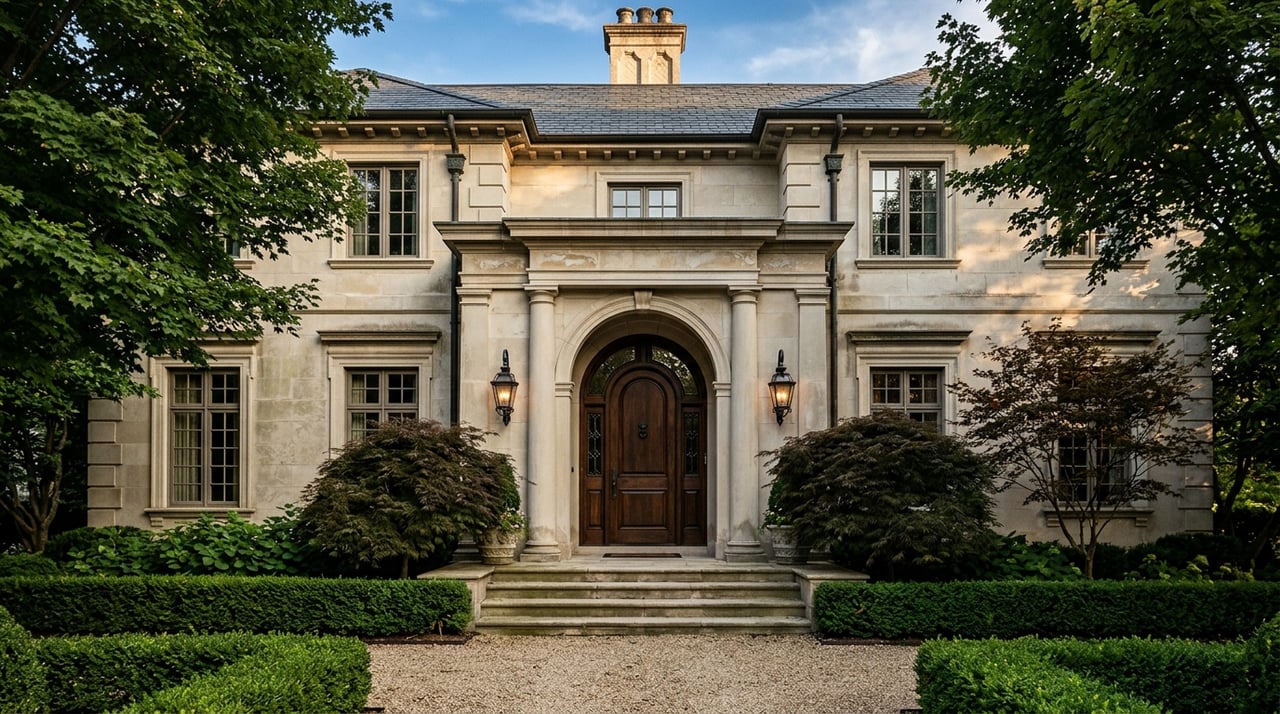
These homes tend to feel formal and highly composed. Their defining features often include symmetry, monumental scale, strong visual axes, and rich ornament.
In practical terms, you will often notice a carefully choreographed sequence. Gates, driveways, gardens, terraces, and the main house all work together to create a sense of arrival.
That is part of what gives Hillsborough’s classical estates their lasting presence. The architecture is important, but so is the procession from edge of property to front door.
What defines classical design
Classical estate homes often include:
- Symmetrical front elevations
- Columns or pilasters
- Formal entries and stairways
- Ornamented exterior details
- Grand rooms and formal garden relationships
- Strong alignment between house, driveway, and landscape
For sellers, these details are often part of the value story. For buyers, they can signal a home where craftsmanship, restoration, and long-term upkeep deserve close attention.
Mediterranean Homes Feel Lighter
Hillsborough also has a strong Mediterranean and Italian Renaissance Revival presence. Villa Rose on Redington Road, identified by the Library of Congress as an Italian Renaissance house built in 1912 as a country retreat, reflects this side of the town’s architectural history.
These homes usually feel more relaxed than Beaux-Arts estates, but they are still elegant and intentional. Rather than emphasizing monumental formality, they often focus on texture, garden living, and indoor-outdoor flow.
You will often see smooth stucco walls, clay tile roofs, arched openings, terraces, balconies, loggias, decorative ironwork, and balanced facades. Those features help these homes feel warm, composed, and very much tied to California living.
For many buyers, this style hits a sweet spot. It can offer estate scale and architectural character without feeling overly rigid or ceremonial.
Why Mediterranean style fits Hillsborough
Mediterranean homes work especially well in Hillsborough because the lots and landscaping support them. Courtyards, terraces, and garden rooms have space to breathe, and mature plantings can soften the architecture while adding privacy.
That relationship between house and grounds is a recurring theme in Hillsborough. The best properties often feel unified, not just well decorated.
Traditional Homes Bring Quiet Formality
Not every notable Hillsborough home is grandly classical or Mediterranean. Colonial Revival, Tudor, and other traditional forms are also part of the town’s architectural mix.
Hillsborough’s design guidelines emphasize that a style should come from an authentic source. That means roof form, facade composition, windows, and trim should work together in a way that is true to the home’s architectural language.
Colonial Revival homes, for example, often rely on symmetry, hipped or gabled roofs, fan or Palladian windows, columns or pilasters, and pronounced porches. The effect is usually more restrained than a Beaux-Arts estate, but still formal and polished.
For buyers, these homes can be appealing because they often balance elegance with familiarity. For sellers, authenticity matters because buyers in Hillsborough tend to notice when renovations respect the original character.
Contemporary Homes Have a Place
Yes, modern and contemporary homes exist in Hillsborough. But the Town is clear that modernism is not the predominant style, and modern proposals receive higher scrutiny during design review, especially early in the process.
That does not mean contemporary architecture cannot work here. It means modern homes are expected to respond carefully to massing, siting, and compatibility with the surrounding context.
For you as a buyer, this is important context. A striking modern home in Hillsborough is not just about clean lines and glass walls. It is also the result of fitting a newer design approach into a town with an established architectural and landscape identity.
For sellers considering updates, this can affect planning. Bold exterior changes may require more than good taste. They may also require a strong compatibility case.
Land Shapes the Architecture
In Hillsborough, the lot is part of the design. The Town’s lot-size handout states that the minimum lot size is one-half acre, hillside lots can have added size requirements, and maximum permitted floor area is based on lot area, using 25 percent of the first acre plus 15 percent over one acre.
Lot coverage is also capped. That helps prevent houses from overwhelming their sites and preserves the spacious character that defines the town.
This is one reason Hillsborough homes often feel balanced even when they are large. The house, driveway, gardens, and open space are expected to work together.
Site conditions also matter in a very practical way. The Town’s public planning materials identify steep slopes, landslide hazards, regional faults, and liquefaction areas, while the Engineering Division handles grading, drainage, streets, sewer and water conveyance, and site development.
So when you look at a Hillsborough property, you are not just evaluating architecture. You are also evaluating how the home addresses slope, access, drainage, and long-term site function.
Landscaping Is Part of the Design
In Hillsborough, landscaping is not an afterthought. The Town’s planning handouts include guidance related to tree protection, tree removal, tree maintenance, and water-efficient landscaping.
That emphasis makes sense because landscape is a major part of the town’s identity. Mature trees, layered planting, and generous setbacks help define how homes look and how private they feel.
The Town also notes that many properties are in the Wildland Urban Interface. Firewise Hillsborough focuses on defensible space, vegetation management, and wildfire-resistive landscaping, which makes landscape planning both an aesthetic and maintenance issue.
For homeowners, this means the grounds can be beautiful and valuable, but they also require stewardship. Trees, slopes, water use, and fire-conscious planting all affect ownership costs and decisions.
Renovating in Hillsborough Takes Strategy
One of the biggest misconceptions about estate properties is that change is simply a matter of budget and design taste. In Hillsborough, exterior work is reviewed closely.
The Residential Design Guidelines say new houses, additions, landscaping, and fencing and gates are covered by design guidance. The Planning Division also notes that larger projects, including new homes with landscaping, substantial additions, subdivisions, and tennis courts, go to the Architecture and Design Review Board.
For owners, that means preserving or improving a property usually involves both design execution and approval strategy. A successful project often depends on understanding compatibility, materials, scale, and process from the start.
This is especially true for architecturally specific homes. Classical homes may require matching stonework, ornament, and formal terrace relationships. Mediterranean homes may depend on compatible stucco textures, roof tiles, ironwork, and arches. Traditional homes may hinge on accurate window proportions, trim details, and porch elements.
Why maintenance can be complex
Upkeep often costs more in Hillsborough because several factors can overlap:
- Large lots and long driveways
- Sloped or geologically sensitive sites
- Mature trees and landscape management
- Specialty exterior materials
- Wildfire defensible-space considerations
- Historically compatible repairs for older homes
The Town’s Carolands Gatehouse offers a useful preservation example. Its reconstruction retained historic ornaments and roof tiles from the original structure while preserving architectural integrity and bridging past and present.
That is a small-scale reminder of a bigger point. In Hillsborough, even secondary estate features can call for thoughtful restoration rather than simple replacement.
What Buyers and Sellers Should Notice
If you are buying in Hillsborough, look beyond style labels. Ask how the architecture, lot, access, landscaping, and maintenance needs work together.
A beautiful facade is only one piece of the picture. You also want to understand site constraints, review considerations for future changes, and the level of care the property may need over time.
If you are selling, architectural clarity can be a real advantage. Buyers respond to homes that feel cohesive, well maintained, and true to their design language.
That is especially important in a market like Hillsborough, where details matter. Presentation, preparation, and a clear story about the home’s style and setting can shape how buyers perceive value.
Whether a property leans classical, Mediterranean, traditional, or contemporary, Hillsborough architecture is most compelling when the house and land feel like they belong together. That is often what separates a beautiful home from a truly memorable estate.
If you are thinking about buying or selling a Hillsborough property and want tailored guidance on positioning, preparation, or off-market opportunities, connect with Sandra Comaroto.
FAQs
What makes Hillsborough architecture different from nearby suburbs?
- Hillsborough stands out because of its estate-scale lots, curving roads, dense landscaping, and town-wide design review culture, all of which shape how homes are built, maintained, and experienced.
Can a modern home fit within Hillsborough architecture?
- Yes, but the Town says modern proposals receive higher scrutiny because modernism is not the predominant style, so siting, massing, and compatibility matter closely.
What architectural styles are common in Hillsborough estate homes?
- Common style families include French Classical, Beaux-Arts, American Renaissance, Mediterranean and Italian Renaissance Revival, Colonial Revival, Tudor, and some contemporary homes.
How much can owners change on a Hillsborough estate property?
- Exterior changes, additions, landscaping, and features like fences or gates are subject to Town review and permits, so changes usually need to align with Hillsborough’s design guidance.
Why can Hillsborough estate maintenance be expensive?
- Costs can rise because of large parcels, slopes, mature trees, specialty materials, wildfire-related landscape needs, and the need for repairs that match the home’s architectural character.