A house on Jackling Drive sold for $25 million last year. Then its new owners carved off a piece of dirt with nothing built on it and sold that alone for $5 million. No swimming pool, no French chateau, no hand-carved staircase salvaged from William Randolph Hearst's collection. Just land, and a buyer willing to pay more for it than most Bay Area families will spend on an entire home.
That single transaction tells you more about how Hillsborough estates actually get valued than any median price you'll find on a portal. If you're comparing Hillsborough to Atherton, Woodside, or anywhere else on the Peninsula using headline sale prices, you're missing where the real money is sitting.
A Sale That Already Made Hillsborough History
The estate at the center of this is well known locally. Built in 1929 by architects John Bakewell Jr. and Ernest Weihe for the family that owned the racehorse Seabiscuit, the French chateau-style home became Bing Crosby's primary residence in 1965 and stayed in the Crosby family for nearly sixty years. After Kathryn Crosby passed away in 2024, the estate came to market in February 2025 with a record-setting ask of $40 million.
It didn't sell at that number. The property closed on June 12, 2025 for $25 million, going to local buyers Mehrdad and Neda Elie. Even at that discount, the sale still surpassed the previous local benchmark, a $23 million transaction known as the "Western White House," and ranked among the top five sales in Hillsborough real estate history. That gap between a $40 million ask and a $25 million close is its own lesson: even a home with this much provenance still gets priced by the market, not by its story.
What the New Owners Did With Their $25 Million
Here's where the transaction stops looking like a typical luxury resale and starts looking like a land play. The Elies spent roughly $3 million renovating the house itself, replacing carpeting with hardwood, updating bathrooms, refreshing the kitchen, and investing close to $400,000 in new landscaping and a pool. That's a fairly conventional prep-and-flip move for a property this size.
What isn't conventional is what they did to the lot. The estate originally spanned about 5.36 acres. The Elies split it into four separate parcels:
- The house itself, now sitting on a reduced 2.4-acre parcel
- Three additional parcels carved from the remaining acreage
The home was relisted in March 2026, less than a year after the purchase, for just under $29 million, with Jennifer Gilson of Golden Gate Sotheby's International Realty and Alex Buljan of Compass sharing the listing. They also changed the address from 1200 Jackling Drive to 1200 Armsby Drive, honoring a name Kathryn Crosby had reportedly always wanted for the property.
The Empty Lot That Outsold Most Homes
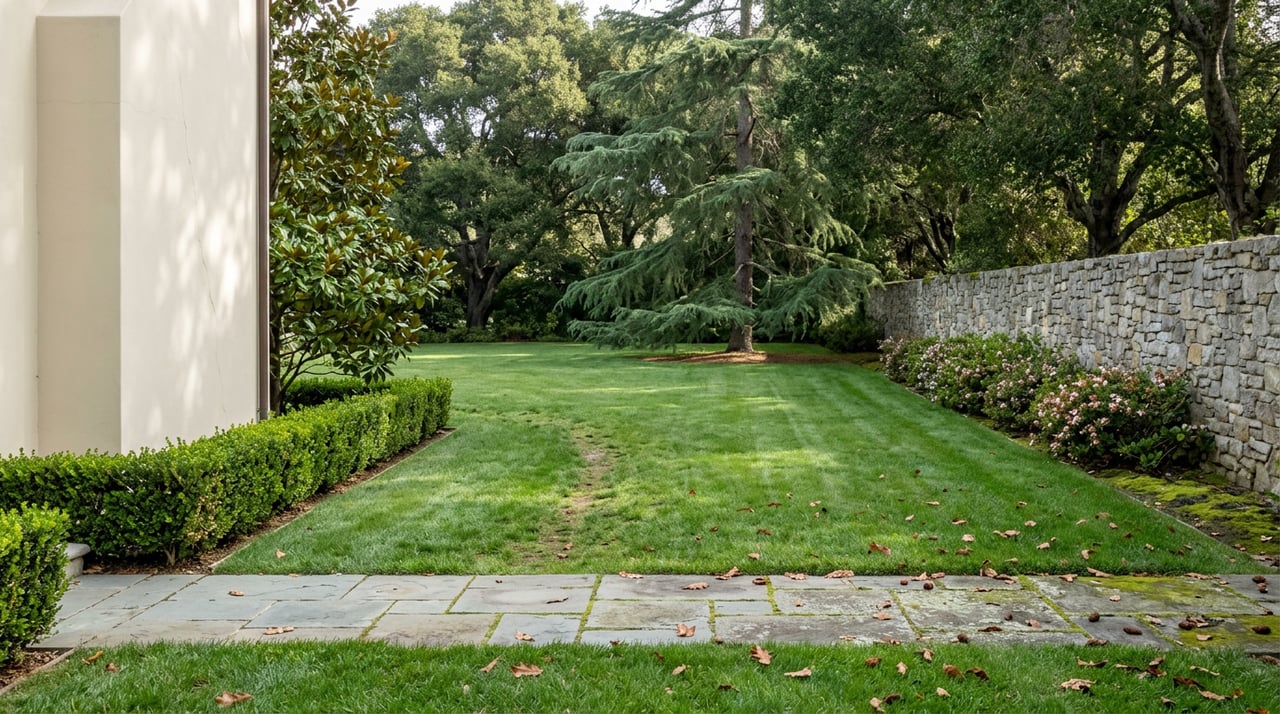
Before the house even went back on the market, one of the three bare parcels sold on its own for $5 million. No structure, no renovation, no Hollywood history attached to it. Just land in Hillsborough.
That number is worth sitting with. Across most of the Peninsula, $5 million buys a finished home with a yard. In this case, it bought an empty lot carved out of a larger estate, and someone paid full trophy-home money for it anyway. As of the March 2026 relisting, the two remaining parcels hadn't sold, with the Elies telling the Wall Street Journal both would eventually come to market.
The Zoning Rule That Makes This Math Possible
None of this works without Hillsborough's underlying zoning. The town requires every residential lot to exceed half an acre, a rule that has shaped the character of the community for decades. It's also the reason a subdivision like this one pencils out so cleanly.
Do the arithmetic on what's left after the house's 2.4-acre parcel: the remaining acreage across three lots averages out to roughly one acre each, comfortably clearing the half-acre minimum with room to spare. In a town with tighter minimum lot sizes, a split like this might not be legally possible at all, or it would leave parcels too small to carry the estate-scale pricing this one commanded. In Hillsborough, the math works in the owner's favor almost by design.
Add Up the Pieces
Put the numbers next to each other and the thesis becomes obvious. The Elies paid $25 million and spent roughly $3 million on renovations, putting their all-in cost at about $28 million. Against that: one bare lot already sold for $5 million, and the renovated house is currently asking just under $29 million. Add those two figures and you get $34 million in value already on the table, and that's before the remaining two parcels ever reach a buyer.
The house alone, the part everyone photographs and writes magazine features about, was never quite worth $40 million to the market. But the estate broken into pieces is already worth more, on paper, than what was paid for it whole. That's not a story about renovation returns. It's a story about land.
What This Means If You're Comparing Hillsborough to Somewhere Else
If you're weighing Hillsborough against another Peninsula town using median sale price as your yardstick, you're comparing structures, not dirt. A median price tells you what typical houses sold for. It says almost nothing about what the underlying acreage would fetch if it were sold bare, and on estate-scale lots, that gap can be enormous.
This matters most for two kinds of buyers and sellers. If you're evaluating an older, larger lot for purchase, the house's condition may be less relevant to long-term value than whether the parcel can be split under current zoning. If you're preparing to sell a legacy property, a straight comparison to recently sold turnkey homes may undersell what you actually own, especially if the lot is large enough to divide.
This is exactly the kind of valuation question that benefits from someone who tracks these transactions as they happen rather than relying on automated estimates. Land value, subdivision potential, and renovation return don't show up cleanly in a comp sheet. They show up in deals like this one.
A Few Questions Worth Asking
Does every large Hillsborough lot qualify for a split like this one? Not automatically. The math above works because the remaining parcels clear the town's half-acre minimum with margin. Older estates on odd-shaped or steeply graded lots may not divide as cleanly, even at a similar total acreage.
Does a bigger lot always mean a higher resale value? Not on its own. Size matters, but so does whether the lot can legally be subdivided, what the resulting parcels would be worth individually, and how quickly a buyer could bring them to market. The Crosby estate case worked because all three of those lined up.
Does this only apply to record-setting sales? No. The mechanics here, renovating a structure while separately valuing and marketing the land beneath it, apply at smaller scales throughout Hillsborough wherever lot size and zoning allow it.
If you're thinking through what a Hillsborough property, large or small, is actually worth once you account for the land underneath it, that's a conversation worth having before you list or make an offer. Comaroto Properties works through exactly this kind of valuation question for Peninsula buyers and sellers every day. Request a personalized consultation to talk through what your property, or the one you're considering, is really worth.